
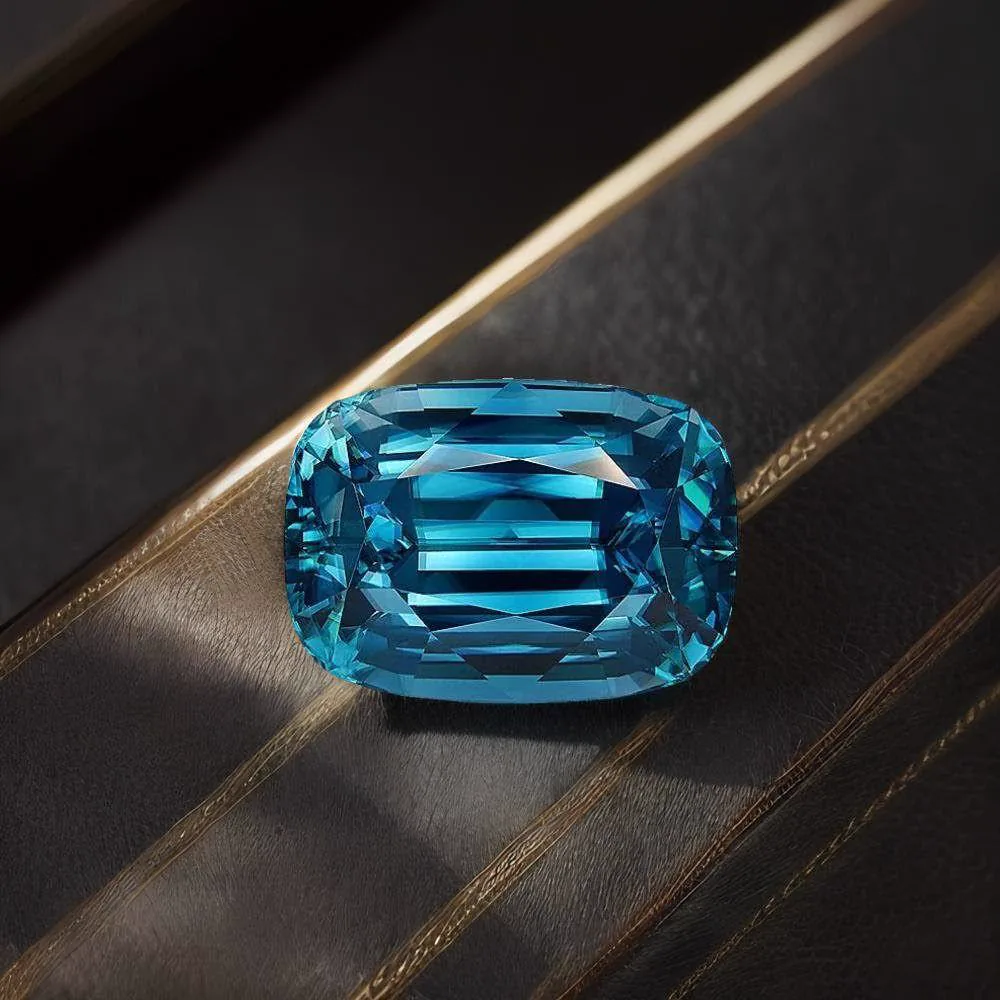
It is not cubic zirconia
Zircon is zirconium silicate, a natural mineral that forms in igneous rock. Cubic zirconia is zirconium dioxide, a synthetic crystal grown in a laboratory since the 1970s as a diamond simulant. The two are unrelated and the similar names are an accident of chemistry.
Zircon is also the oldest mineral anyone has found on Earth. Crystals from the Jack Hills in Western Australia have been dated to roughly 4.4 billion years, which puts them within a few hundred million years of the planet itself. Geologists use zircon for dating precisely because it survives everything.
Where the blue comes from
Essentially all blue zircon on the market starts as brown or reddish-brown rough from Ratanakiri province in Cambodia.
Heating that material to around 900 to 1000 degrees Celsius in a reducing atmosphere turns it blue. The treatment is universal for this colour, stable, and expected by everyone in the trade. Any seller presenting blue zircon as untreated is either mistaken or not worth buying from.
The same process produces colourless and golden zircon depending on the atmosphere and the starting material.
The optics are the point
Zircon has a refractive index between 1.92 and 1.98. Sapphire sits at 1.76 and diamond at 2.42, so zircon bends light far harder than any other common coloured stone.
Its dispersion, the effect that splits white light into spectral colours, measures 0.039. Diamond measures 0.044 and sapphire only 0.018. In practice a well cut blue zircon throws visible flashes of orange and red out of a blue stone, which is unusual and is what people notice across a room.
Zircon is also strongly doubly refractive, with a birefringence of 0.059. Look through the table at a slight angle and the back facet edges appear doubled. That doubling is visible without magnification in larger stones and is a quick way to confirm you are looking at natural zircon.
Brittleness is the real limitation
Zircon rates 6.5 to 7.5 on the Mohs scale, which sounds adequate. Hardness is not the problem. Zircon is brittle, and brittle stones chip along facet edges even when nothing scratches them.
Older zircons often show worn, slightly frosted girdles and softened facet junctions from rubbing against other stones in a jewellery box. That wear is characteristic and it is avoidable.
Store blue zircon separately. Set it in pendants, earrings and protected ring designs with a bezel or recessed shoulders rather than exposed claws. Never put it in an ultrasonic cleaner. Warm soapy water and a soft brush are all it needs.
What to look for
The best colour is an even, slightly greenish to pure blue with no grey. Grey is the common fault and it flattens the stone under indoor light.
Large sizes are available and affordable compared with sapphire, so there is no reason to accept a stone with a window or a weak polish. Check the girdle and the facet edges under ten times magnification for existing chips before you buy, especially on any stone that has been previously set.
Looking for a stone like this?
We keep stock in Bangkok and answer questions about grading, treatment and price without pressure.

Join the conversation
Ask a question or share what you have seen. We read every comment and reply to the good questions.
Loading comments