Why coloured stones play by different rules
Diamond grading built the 4Cs. Colour tells you how little colour a diamond shows. Clarity tells you how few marks it has. Cut tells you how well it returns light. Carat tells you the weight. Every diamond chases the same ideal, which is colourless, clean and brilliant, so the grades compare like with like.
Coloured stones have no single ideal. A ruby should be red. A tanzanite should be blue violet. A green tourmaline should be green. The colour is the product, so it leads everything else. Clarity expectations change from one species to the next. Cut has to protect colour as well as sparkle. And the same weight gives a very different size from one gem to another.
No universal price table exists either. Two stones of the same species and weight can sit ten times apart in price. The four Cs explain why. Learn them in the right order and you can read almost any listing.
Colour. Hue, tone and saturation
Colour carries most of a coloured stone's value, so start here. Gemologists split colour into three parts. Once you see them separately, descriptions like vivid blue or dark and dull start to make sense.
- Hue
- The colour family, such as red, blue or green. Many stones carry a second hue, like a blue with a hint of green. That second hue matters more than most buyers expect.
- Tone
- How light or dark the colour looks, from almost clear to almost black. Most fine stones sit in the middle. A stone that is too light looks washed out. A stone that is too dark looks black in a dim room.
- Saturation
- How strong and pure the colour is. A saturated stone looks rich. A stone with low saturation looks grey or brown, even when the hue is right.
The best colours pair medium tone with strong saturation. That is why a vivid mid blue sapphire beats a very dark one of the same size.
Light changes colour. Look at a stone in daylight near a window, under a warm lamp and under a cool white bulb. Some stones hold steady. Others move a long way. Alexandrite, zultanite and many garnets change a lot. Screens change colour too. A phone photograph shows you the phone as much as the stone. Ask for a short video in daylight and compare it to what arrives.
Crystals also show different colours from different directions. Gemologists call this pleochroism. Tanzanite shows blue and violet. Tourmaline turns dark down its length. Good cutters turn the stone so the best colour faces up.
Clarity. What to expect depends on the gem
Clarity describes the inclusions inside a stone. Inclusions are the small crystals, needles, cracks and cloudy areas that formed as the gem grew. Diamonds get graded on one fixed scale. Coloured stones do not, because the species differ so much.
GIA sorts coloured stones into three types by how clean the stone normally is.
- Type one
- Stones that are usually clean to the eye. Aquamarine, topaz and tanzanite belong here. Buyers expect no visible inclusions, and a visible one counts as a real flaw.
- Type two
- Stones that often carry some inclusions. Ruby, sapphire, spinel and green tourmaline fit here. A few small ones you cannot see face up are normal.
- Type three
- Stones that nearly always have inclusions. Emerald and rubellite are the usual examples. Buyers accept visible inclusions and judge how much they hurt the beauty.
Eye clean means you cannot see inclusions with normal eyesight at a normal distance. It is the practical goal for most stones. A loupe shows more, but nobody wears a gem under a loupe.
Look at what kind of inclusion you have. Small crystals and fine needles usually cost you little. A cloud that softens the colour costs more. Fractures that reach the surface matter most. They catch on clothing, and a knock opens them. A fracture near the edge is a durability problem, not just a cosmetic one.
Some inclusions help. Fine needles in a ruby show that it grew naturally and help a lab identify it. A spotless stone is not always the better stone. Ask what the inclusions are and where they sit.
Cut. Shape, proportion and the window
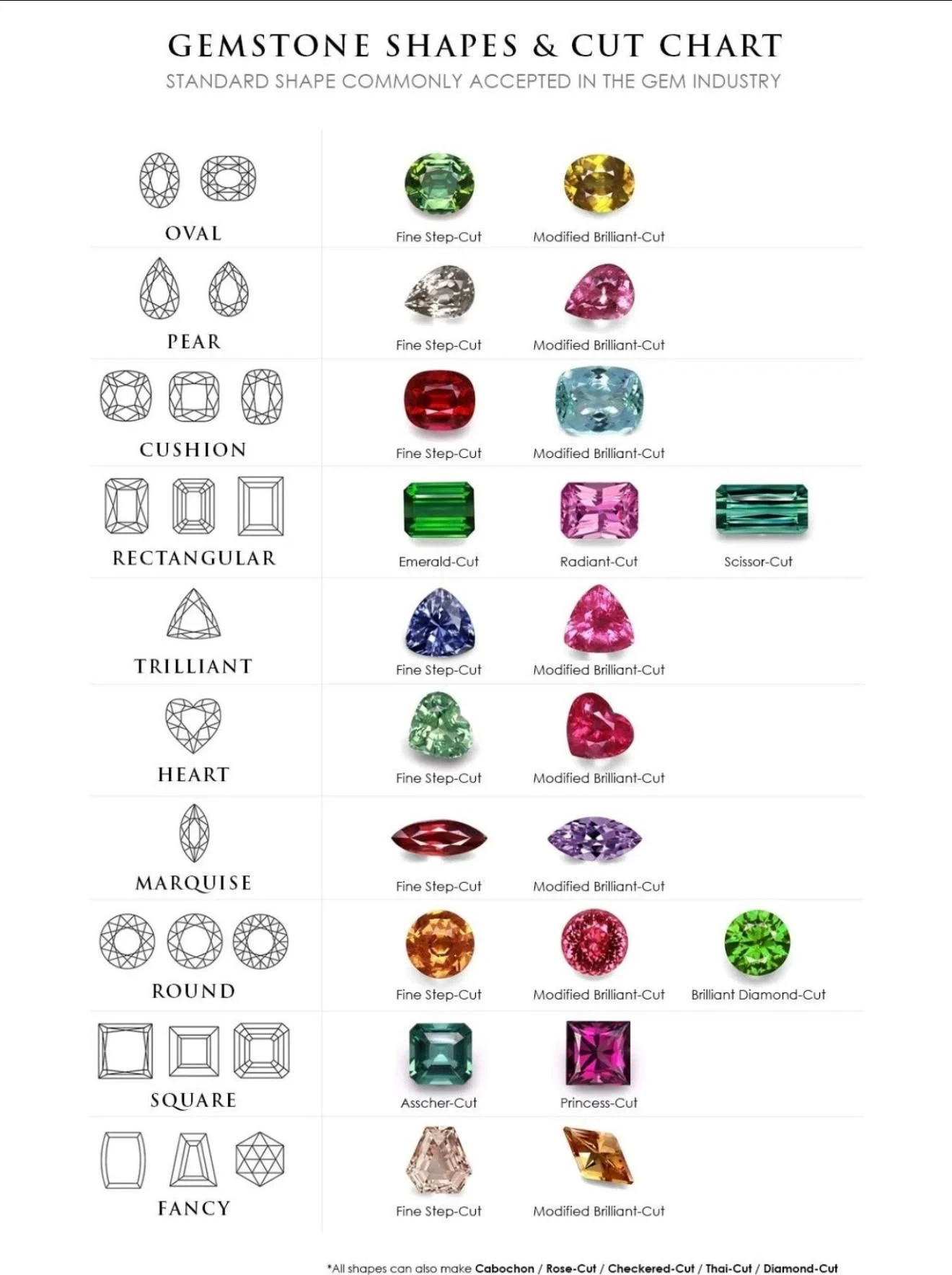
The chart above shows the standard shapes used across the trade. They are oval, pear, cushion, rectangular, trilliant, heart, marquise, round, square and fancy. Each shape appears in two or three cutting styles. The style changes how the stone looks as much as the shape does.
- Step cut
- Long, flat facets arranged in rows like stairs. The emerald cut, Asscher cut and scissor cut are step cuts. They show colour depth and calm, clean flashes. They also show inclusions clearly, so they suit clean stones.
- Brilliant cut
- Many small triangular and kite shaped facets that scatter light. Round brilliants and most ovals and pears use this pattern. It hides inclusions and adds sparkle, which helps stones with pale colour or lower clarity.
- Modified brilliant
- A brilliant pattern adapted to a shape other than round. The chart lists it beside the step cut for most shapes, and most coloured stones you see carry it.
- Cabochon
- A smooth domed polish with no facets. It suits opaque and translucent stones, and stones with a star or a cat's eye.
The note at the bottom of the chart makes one more point. Every shape can also be cut as a cabochon, a rose cut, a checkerboard cut, a Thai cut or a diamond cut. The shape is your choice. The cutting style is a second choice.
Cutting a coloured stone is a compromise. Rough costs a lot, and the cutter has to choose between weight and beauty. A stone cut for weight keeps every possible carat and often ends up too deep, too shallow or lopsided. Three faults show up again and again.
- Window
- A pale, see through area in the middle of the stone. The stone is too shallow, so light leaks out the back instead of returning colour.
- Extinction
- Dark patches that move across the face when you tilt the stone. A little is normal. A large dark area means poor angles.
- Depth
- A deep stone hides weight in its base. You pay for carats you cannot see face up, and the stone looks small for its price.
Judge the cut face up. Tilt the stone slowly. Look for an even spread of colour, lively light across the whole face and no obvious window. Check the outline too. It should be even, and the facets should meet cleanly.
Shape changes price. A round cut wastes more rough than an oval or a cushion, so rounds often cost more per carat. Shapes that follow the natural crystal waste less rough, so they cost less to make.
Carat. Weight is not size
One carat equals 0.2 grams. Carat measures weight, not size. Gems differ in density, so equal weights give different sizes.
- Ruby and sapphire
- Density about 4.0. They are heavy for their size, so a one carat stone looks small.
- Spinel
- Density about 3.6. Close to a diamond, so it looks similar in size at the same weight.
- Tourmaline
- Density about 3.05. It looks larger than a ruby of the same weight.
- Emerald and aquamarine
- Density about 2.7. A one carat stone carries nearly half as much stone again as a one carat ruby.
- Quartz
- Density about 2.65. Amethyst and citrine look big for their weight.
So compare millimetres, not just carats. Ask for length, width and depth. Two three carat stones of the same species can differ by a millimetre or more if one is cut deep.
Price per carat rises with size, and it jumps at round numbers. A 0.95 carat stone often sells for noticeably less per carat than a 1.00 carat stone of the same quality. The same jump happens at two, three, five and ten carats. A stone cut just under a round weight can be a smart buy. Always confirm the total price, not just the price per carat.
Availability differs by gem. Tanzanite and aquamarine come in large, clean sizes. Fine ruby and spinel above three carats are much scarcer, and their prices climb faster.
Beyond the four. Treatment, origin and reports
Coloured stones need three more questions that diamonds mostly skip.
- Treatment
- Most sapphires and rubies are heated. Tanzanite is heated. Some emeralds are oiled. Heat is accepted and stable in these gems. The seller must disclose it, and unheated stones sell at a large premium. Other treatments, such as fracture filling or diffusion, lower the value. Get the treatment in writing.
- Origin
- Where a stone formed changes the price of some gems. Burmese ruby, Kashmir sapphire, Colombian emerald and Brazilian paraiba tourmaline carry premiums. A lab gives origin as an opinion based on chemistry and inclusions, and not every stone gets one.
- Report
- A report from an independent lab confirms the species, notes treatment and sometimes gives an origin. It does not grade beauty. Ask for one on any stone worth serious money. GIA, Gübelin and GRS all issue them.
A simple order for buying
Put the pieces together in this order and you compare stones on what you see, not on what the listing says.
- 1. Colour
- Decide the colour you love. Judge it in daylight. Skip the stone if the colour disappoints, whatever the numbers say.
- 2. Cut
- Check the face up look, the window, the dark patches and the outline. Ask for measurements in millimetres.
- 3. Clarity
- Set your standard by species. Expect eye clean in type one stones. Accept some inclusions in type three.
- 4. Carat
- Set your budget, then find the best colour and cut inside it. Look at stones just under a round weight.
- 5. Papers
- Confirm the treatment. Ask for a lab report when the price justifies it.
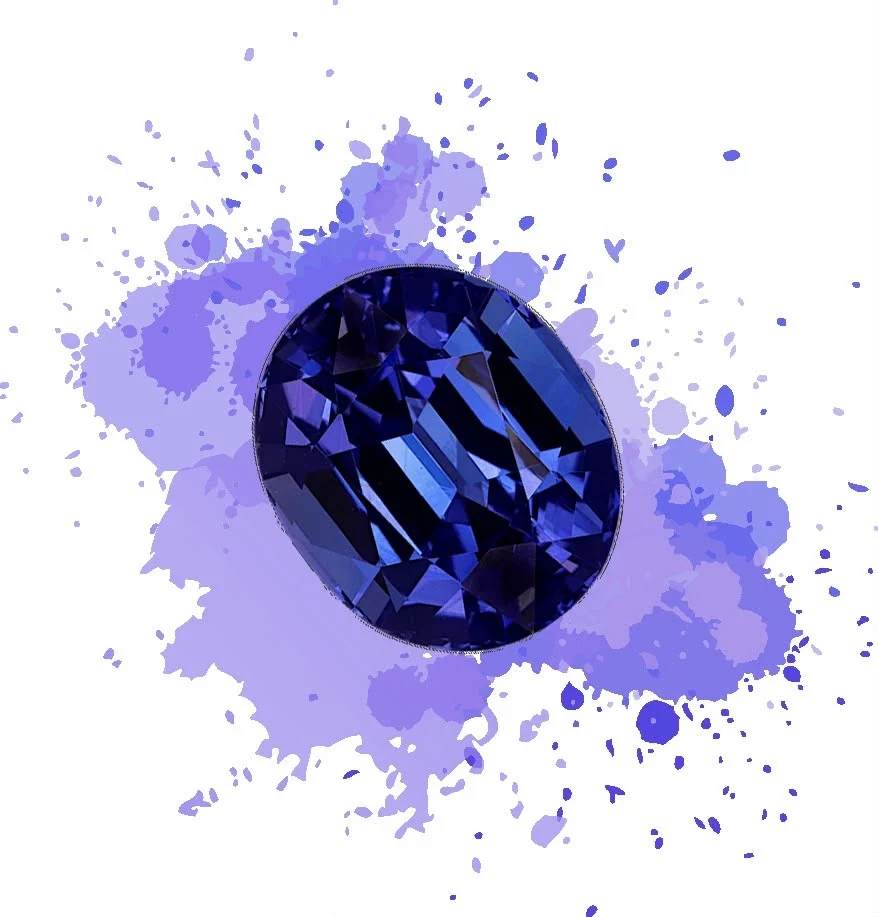
Looking for a stone like this?
We keep stock in Bangkok and answer questions about grading, treatment and price without pressure.

Join the conversation
Ask a question or share what you have seen. We read every comment and reply to the good questions.
Loading comments