A prospector's mistake
In 1907, a prospector named James Couch found blue crystals in the San Benito Mountains of central California. He thought he had found sapphire. Tests said otherwise. The crystals belonged to a mineral no scientist had recorded.
The geologist George Louderback described it and named it in 1909 after San Benito County. On 1 October 1985, California made benitoite its official state gem.
One mine, and why that matters
Commercial gem quality benitoite comes from one place, the Benitoite Gem Mine in the New Idria district of San Benito County. Nothing else in the world produces it in real quantity. Small crystals turn up in a few other regions, but none of them yield cut stones.
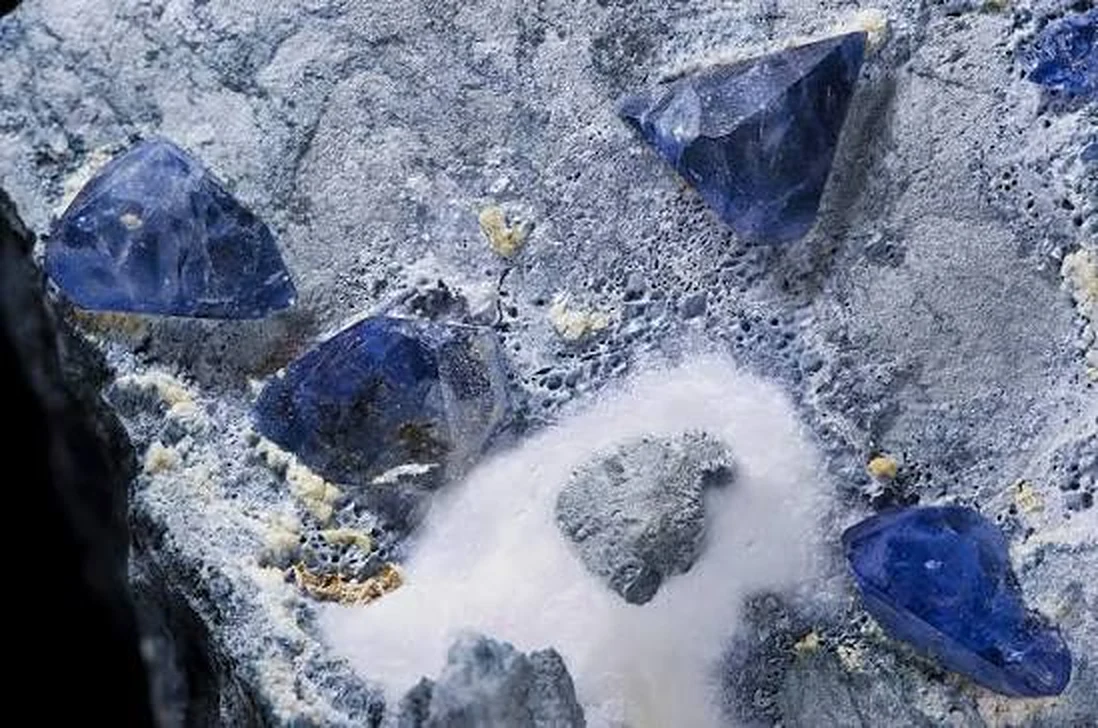
The crystals grow inside fractures in altered blue schist within serpentinite. Hot fluids moved through the rock, and benitoite crystallised in the cracks. It sits with white natrolite, black neptunite and orange brown joaquinite, and collectors prize these combinations on their own.
Commercial mining has largely stopped, and new faceted stones reach the market in small numbers. Old stones move between collectors, and the supply of fine ones shrinks each year.
The New Idria district
The New Idria district is better known for mercury than for gems. Miners worked cinnabar there for many decades. The benitoite lies in a small area of the same range, inside the serpentinite that dominates those hills.
Serpentinite forms when seawater alters rock from the deep ocean floor. Blue schist, the rock that holds the benitoite, forms under high pressure and low heat, where a slab of ocean floor sinks beneath a continent. That geology explains why the gem grows there and almost nowhere else.
What benitoite is
Benitoite is a barium titanium silicate. Barium and titanium give it two unusual traits. Its refractive index is very high, and its dispersion, which is the splitting of white light into colours, sits close to that of a diamond. That is why a well cut benitoite throws flashes of colour that a sapphire cannot match.
- Hardness
- 6 to 6.5 on the Mohs scale. Softer than sapphire, close to tanzanite.
- Refractive index
- About 1.76 to 1.80. High, so the stone looks lively.
- Dispersion
- Close to a diamond, which gives strong coloured flashes.
- Double refraction
- Strong. You can see the back facet edges doubled through the table.
- Colour
- Blue to colourless. Some crystals show purple.
- Ultraviolet glow
- Bright blue white under short wave UV light.
Fire, in plain words
Brilliance is the white light that returns to your eye. Fire is the coloured flashes. Dispersion measures how strongly a gem splits white light into colours. Diamond disperses at 0.044, and benitoite sits close to that figure. Sapphire disperses at 0.018, less than half as much.
The blue body colour hides some of the fire, but you still see it in the flashes at the edges of the facets. Under a spotlight, a well cut benitoite throws orange and red sparks that a sapphire of the same size shows far less.
How cutters work benitoite
Most crystals are small, thin and flat, so cutters work on pieces under a carat. Because the blue shows through one direction, the cutter must orient the crystal before every cut. A bad guess leaves a pale stone.
The strong double refraction adds a second challenge. Look through the front of a cut benitoite and the back facet edges appear doubled. Buyers often mistake that for a flaw. It is a normal property of the species.
The glow and the colour
Put benitoite under a short wave ultraviolet lamp and it lights up in a vivid blue white. Dealers use this as a quick check. Few blue stones behave that way.
The colour itself is a strong, saturated blue, sometimes with a violet tint. Benitoite is dichroic, which means the crystal shows blue in one direction and almost no colour in another. Cutters turn the rough until the blue faces up. Turn a finished stone and you watch the blue fade and return. That is normal.
Look for medium to dark blue with strong saturation. Very pale stones look weak. Very dark stones lose the fire that makes benitoite special.
Clarity, size and price
Most benitoite crystals are small. Pieces near half a carat are common at the mine. Clean material above two or three carats is hard to find. The largest faceted benitoite on record weighs 15.42 carats, and stones of that size sit far outside normal trade.
Price follows size and colour, and it moves in steps. Clean, well coloured stones above two carats reach thousands of dollars per carat. Total prices grow quickly because weight and price per carat rise together.
Small inclusions of other minerals from the host rock sometimes appear. A bright, clean stone with no visible marks commands the highest prices.
Benitoite compared with sapphire and tanzanite
People often ask how benitoite compares with the blue stones they know better. These two comparisons cover most of it.
- Against sapphire
- Sapphire rates 9 on the Mohs scale and benitoite rates 6 to 6.5. Sapphire wins on durability. Benitoite wins on fire and on its single source and rarity.
- Against tanzanite
- Both share similar hardness. Tanzanite comes in large sizes at modest prices and shifts between blue and violet. Benitoite is far scarcer, smaller and more expensive, with a purer blue and stronger sparkle.
Care and wear
At hardness 6 to 6.5, benitoite scratches from ordinary dust and chips under a hard knock. Earrings and pendants suit it best. A ring works with a protective setting and occasional wear.
Clean it with warm soapy water and a soft brush. Skip ultrasonic cleaners and steam. Store it in a soft pouch apart from harder gems, and remove it before any housework, gardening or exercise.
How to buy benitoite
Because California is the only real source, origin is rarely in question. Species is the concern, because several blue stones imitate benitoite. A UV test and a lab report handle that.
- Ask for a lab report
- It should name benitoite, give the weight and note any treatment.
- Check the glow
- A seller who knows the species can show you the UV reaction.
- Look at colour in daylight
- The blue should stay strong outdoors, not go grey.
- Check the cut
- Benitoite lives on its fire. A shallow or lopsided stone wastes the reason to buy it.
- Get measurements
- Length, width and depth in millimetres, as with any stone.
Gems and mineral specimens
Two markets exist for benitoite. Gem buyers want cut stones. Mineral collectors want crystals on their host rock, like the ones in the photo, sometimes with white natrolite and black neptunite around them. GIA notes that crystals up to two inches across have been found.
- Can I wear benitoite every day?
- A protective setting and gentle wear give it a long life in a ring. Earrings and pendants suit it better.
- Why does my stone look colourless from some angles?
- Benitoite is dichroic. The blue disappears when you view the crystal along one direction. A well cut stone hides the pale direction from the front.
- Do I need a lab report?
- Yes. It confirms the species and records any treatment. It also gives you the paperwork you need if you sell later.
- Will it hold its value?
- Nobody can promise that. Supply is small and demand from collectors is steady. Buy it because you want to own it.
Looking for a stone like this?
We keep stock in Bangkok and answer questions about grading, treatment and price without pressure.

Join the conversation
Ask a question or share what you have seen. We read every comment and reply to the good questions.
Loading comments