A gem with no fixed colour
Tourmaline is a family of minerals, not a single one. It shows nearly every colour a gem can show, and sometimes several in one crystal. The name comes from a Sinhalese word for mixed coloured stones. Few names have fitted a gem so well.
Green is the colour you meet most often. Brazil, Mozambique, Nigeria, Afghanistan, Namibia, Tanzania and Madagascar all produce it. So do Maine and California in the United States. Because green comes from so many places, quality and price cover a huge range.
The trade calls plain green tourmaline verdelite. The word tells you the colour, not the quality. A verdelite can be a dull olive or a glowing lime.
A short history of a confusing gem
Tourmaline took a long time to earn its own identity. Because it appears in every colour, early buyers mistook it for other gems. Green stones passed as emerald and red stones passed as ruby. Dutch traders who brought crystals from Sri Lanka in the 1700s called them ash pullers, because a warm crystal draws ash toward it.
Chemists sorted the family out in the nineteenth century and showed that all those colours belong to one mineral group. In 1820, two young men found tourmaline on Mount Mica in Maine. Many accounts call it the first gem discovery in the United States.
Today tourmaline is one of the two official birthstones for October, next to opal.
Where the green comes from
Different trace elements make different greens. Knowing the cause helps you understand what you are looking at.
- Iron
- Iron, sometimes with titanium, creates most green and blue green tourmaline. Expect shades from olive and bottle green to a cool bluish green. This is the standard verdelite.
- Chromium and vanadium
- These two elements create chrome tourmaline, a rich, deep green close to emerald. Chrome tourmaline sells at a premium, and fine stones above a few carats are hard to find.
- Copper
- Copper pushes tourmaline toward electric blue and green. That is the paraiba family. Our article on Ethiopian paraiba covers it in full.
The many greens
Sellers use several names for green tourmaline. They describe the look, and none of them has a legal definition.
- Verdelite
- The general name for green tourmaline. Colours run from yellowish green to bluish green.
- Chrome tourmaline
- A vivid, saturated green with little yellow or blue. The most valued green.
- Mint
- A light, cool green with low saturation. Soft and easy to wear. It costs less than deeper greens.
- Bicolour
- One stone that shows two colours side by side, such as green and pink or green and colourless.
- Colour zoned
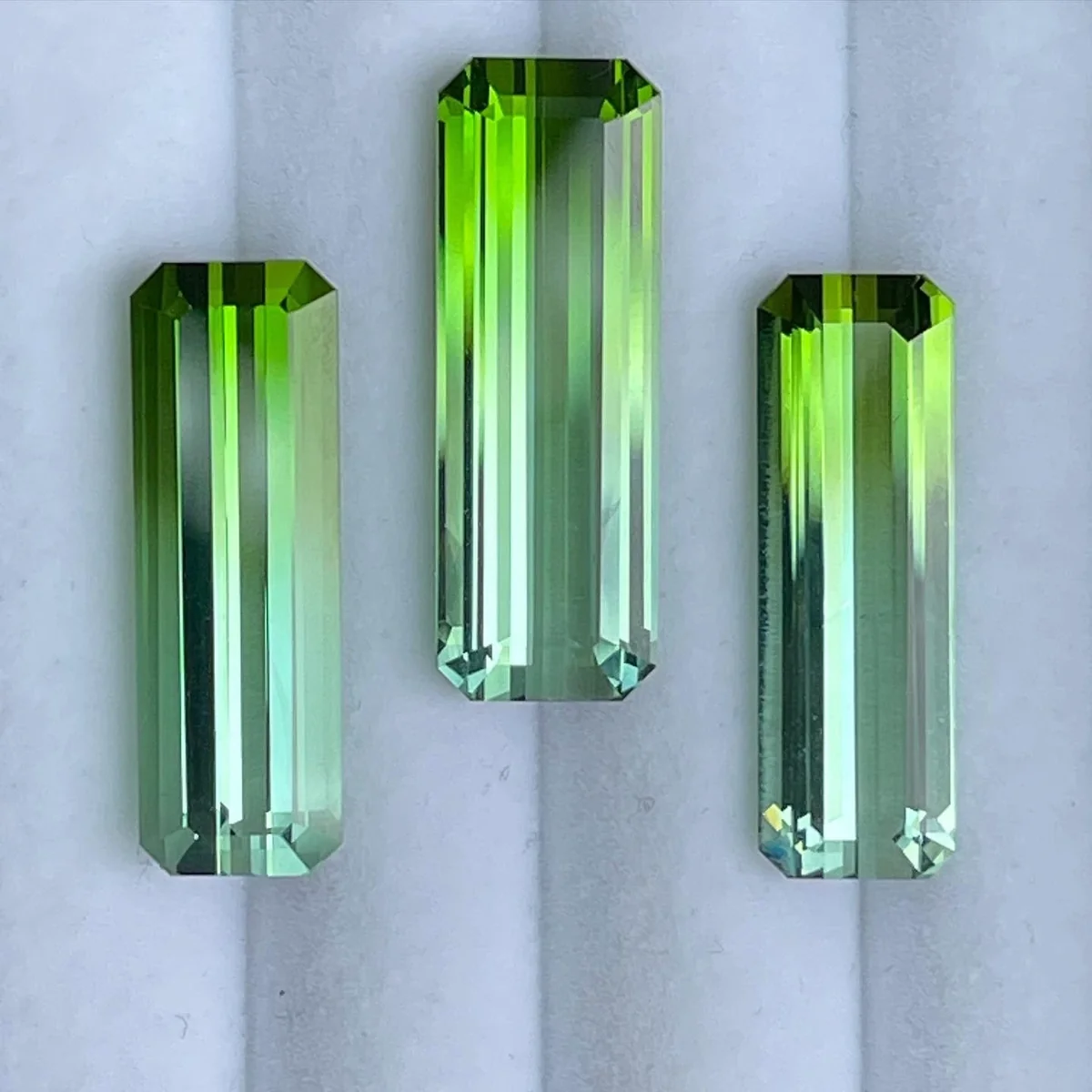
- A stone whose green shifts along its length, like the stones in the photo above.
Tourmaline crystals often change colour as they grow. The three stones in the photo start as lime green at the top and fade to a cool blue green at the base. Cutters keep that zoning on purpose. They cut long, narrow step cuts to show the full gradient in one stone. Many collectors love these. Others prefer a single even colour.
Watermelon, bicolour and cat's eye stones
Three special forms of tourmaline deserve a closer look. Each one turns a natural quirk into a feature.
- Watermelon
- A crystal with a pink core and a green outer layer, or the reverse. Cutters slice the crystal across its width to show both colours in rings, like the fruit. Slices suit pendants, and fine ones with a sharp colour boundary cost the most.
- Bicolour and tricolour
- Cutters orient a long crystal so the colours run down the length of one stone. A clean, sharp line between the colours costs more than a soft blend.
- Cat's eye
- Fine tube like inclusions line up inside some stones. When a cutter polishes the stone as a cabochon, a bright line of light moves across the surface. It appears most often in green, blue and pink stones. The eye should be sharp, centred and straight.
Cutting for colour
Tourmaline shows strong pleochroism. Look at a crystal end on and you see a dark colour. Look at it from the side and you see a lighter one. Cutters use this to control the finished stone.
Dark crystals get cut lengthwise, with the table parallel to the long axis. That lightens the colour and lets it glow. Pale crystals get cut end on, which deepens the colour. A good cutter studies the rough in several directions before touching a wheel.
That is why so many green tourmalines come as long rectangles. The shape follows the crystal. It also saves rough. You can pay less for a well cut elongated stone than for a round one of the same colour, because the round cut wastes more material.
Clarity and what to check
Green tourmaline belongs to GIA's type two group. Many stones look clean to the eye, and you can reasonably expect that in a fine one. Small inclusions inside the stone appear in most crystals. Look for these problems.
- Fractures
- Cracks that reach the surface weaken the stone. Avoid them, especially near the edges of long stones.
- Liquid trails
- Rows of tiny liquid filled channels. They are common and harmless when you cannot see them face up.
- Colour uniformity
- Check that the colour changes only where you want it to. A sudden stripe in a stone sold as even green is a flaw.
- The window
- A pale area in the centre of a long step cut. It means the stone is too shallow.
Treatment and durability
Most green tourmaline is sold as it came out of the ground, apart from cutting and polish. Some very dark stones get heated to lighten them, and heat also shifts some blue and blue green colours. Irradiation matters more for pink and red tourmaline than for green. Ask every seller and get the answer in writing.
Tourmaline scores 7 to 7.5 on the Mohs scale, which makes it tough enough for rings. The colour does not fade in normal light. It has an odd quirk. Heat and friction charge the crystal with static electricity, so a warm stone can pick up dust and lint. Wipe it and the problem goes away.
Clean it with warm soapy water and a soft brush. Skip the ultrasonic cleaner if the stone has fractures or liquid filled inclusions.
Green tourmaline compared with emerald and peridot
Buyers often shop for green tourmaline when they want a green stone and have looked at other options first. These comparisons help.
- Emerald
- Emerald rates 7.5 to 8 and carries heavy inclusions, and fine stones cost many times more. Chrome tourmaline gives a similar green with better clarity at a fraction of the price.
- Peridot
- Peridot rates 6.5 to 7 and stays yellow green. Green tourmaline offers a wider range of greens, including cooler blue greens, and a harder surface.
- Tsavorite garnet
- Tsavorite shows a vivid green with high brilliance and usually costs more per carat than tourmaline. It is scarcer in large sizes.
Long stones have corners and ends that take knocks, so choose a setting that protects them. A bezel or a four claw setting works well. Rings suit tourmaline better than most coloured stones because of its hardness, but a protective setting still adds years to the stone.
Price and how to choose
Colour sets the price. Common olive and bottle greens sell for tens of dollars per carat. Bright, clean greens sell for more. Vivid chrome stones sell for hundreds of dollars per carat and up.
Tourmaline has a density of about 3.05, so it looks larger than ruby or sapphire at the same weight. That gives you a lot of stone for your money. Clean stones of five carats and above appear regularly, which makes tourmaline a strong choice when you want size.
- Pick the green first
- Decide between lime, forest, mint and chrome, and compare only within that group.
- Check the length
- Long stones cost less for their face size. Ask for measurements.
- Look at the ends
- On zoned stones, check that the colour transition looks natural and smooth.
- Ask about heat
- Get the treatment in writing.
Looking for a stone like this?
We keep stock in Bangkok and answer questions about grading, treatment and price without pressure.

Join the conversation
Ask a question or share what you have seen. We read every comment and reply to the good questions.
Loading comments