The discovery in Sri Lanka
In 1902, two researchers named G.T. Prior and A.K. Coomaraswamy described a new mineral from a spot near Ambakotte in Sri Lanka. They called it serendibite, after Serendib, the old Arabic name for the island. The same name, in its Serendip form, gave English the word serendipity.
The mineral stayed a curiosity for a century. Before 2005, only three faceted serendibites were known, and all came from that first Sri Lankan find. Then miners in Mogok, Myanmar, uncovered more, and the number of cut stones grew. The total is still tiny next to any other gem.
What serendibite is
Serendibite is a silicate of calcium, magnesium and aluminium that also contains boron. Boron is the key. Most gem minerals never see much of it. Serendibite needs it, and that requirement explains the rarity.
The geology is specific. Granite pushes into limestone or marble, and hot fluids rich in boron soak into the carbonate rock. This creates a skarn, a rock full of unusual minerals. Serendibite forms there, next to spinel, diopside, calcite and tremolite. A skarn with the right mix of boron, aluminium and magnesium is uncommon, and one that grows crystals clear enough to cut is rarer.
- Hardness
- 6.5 to 7 on the Mohs scale. Tough enough for careful wear.
- Refractive index
- About 1.70. Similar to spinel, which is why the two look alike.
- Density
- 3.42 to 3.52, close to a diamond.
- Cleavage
- None observed, which helps cutting and durability.
- Crystal system
- Triclinic, with repeated twinning common in the crystals.
Skarns, in plain words
A skarn forms where hot, mineral rich fluids from a granite soak into limestone or marble. The carbonate rock reacts with the fluids and turns into a coarse mix of new minerals. Garnet, diopside, spinel and many others grow in skarns.
Serendibite needs an extra ingredient. Boron travels in the fluids from some granites, and it must reach a rock that also holds enough magnesium and aluminium. Most skarns miss one of these. Serendibite grows only where all of them meet, which explains why so few places in the world have produced it.
The colours
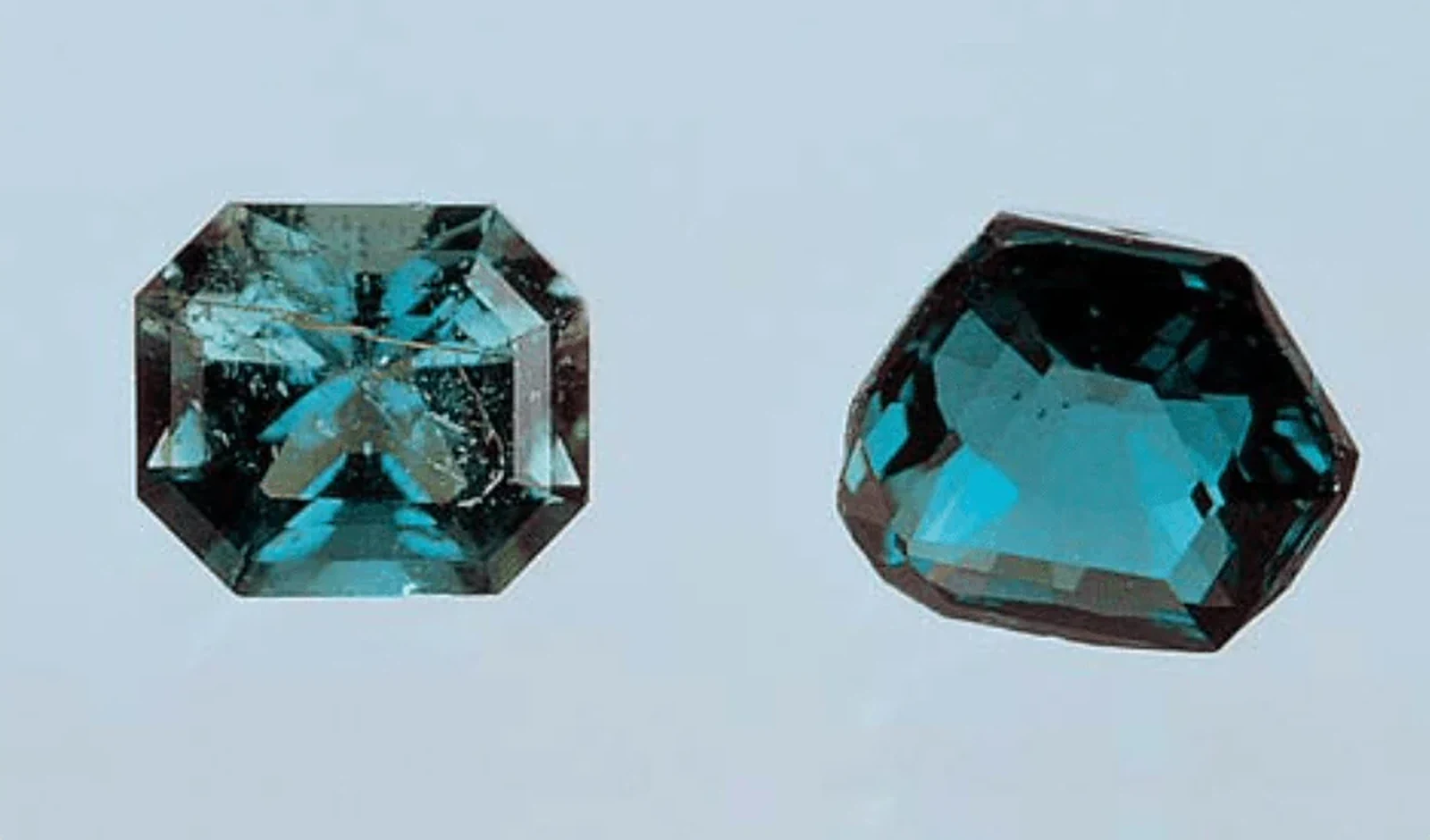
Serendibite runs from pale yellow through blue green and grey blue to black. Most cut stones look dark. Sri Lankan stones were described as greenish blue or violet blue. The Myanmar material that followed tends toward deeper, darker tones, and many stones are close to black.
A vivid blue or green serendibite is the exception. Collectors chase it, and it commands a large premium over the darker stones. The photo above shows two blue green stones.
Where it turns up
Three areas matter. Sri Lanka gave the original find and still produces small amounts around Ratnapura. Mogok in Myanmar has supplied most of the cut stones since 2005. Madagascar has reported occurrences too.
Serendibite turns up as an occasional find in gem workings, and cutters keep any clean crystal they spot. Supply cannot rise with demand. A buyer who wants one waits until a stone appears.
The Mogok find
Mogok, in northern Myanmar, has produced ruby, sapphire and spinel for centuries. Serendibite was found there in 2005. The discovery changed the supply of cut stones from almost none to a small trickle.
Stones from Mogok tend to look darker than the original Sri Lankan material, and many look black.
Size, price and what to expect
Almost every faceted serendibite weighs under one carat. A clean stone above one carat is a major event for a collector. Cutters take the largest, cleanest piece they can and keep every fraction of a carat, so shapes often follow the rough rather than a classic outline.
No reliable price table exists. Stones sell one at a time, usually to collectors, museums and dealers who know the species. Price depends on size, colour and clarity, and it climbs sharply when a stone combines all three. Treat any listing with a low price as a warning sign.
The look alikes
Several dark blue green gems share serendibite's colour range. Their numbers differ from each other, and that is what a lab reads.
- Spinel
- Refractive index about 1.72, close to serendibite's 1.70. Hardness 8. It forms in the same skarns, so the two often sit side by side.
- Tourmaline
- Refractive index 1.62 to 1.64, lower than serendibite. It shows strong pleochroism and comes in far larger sizes.
- Sapphire
- Refractive index 1.76 to 1.77 and hardness 9. It feels heavier than serendibite and lasts longer in daily wear.
- Kornerupine and sapphirine
- Both contain magnesium, aluminium and silicon, and both occur in similar rocks in Sri Lanka and Myanmar. Their chemistry and structure differ from serendibite's.
Why you need a lab report
Serendibite overlaps with several dark blue green stones. Spinel, tourmaline, sapphire, kornerupine and sapphirine all appear in the same mining areas, and to the eye they look alike. Only lab testing separates them, because the difference lies in chemistry and structure, not colour.
That makes a report from a major laboratory the single most important document. It should name serendibite, state the size, and record any treatment. Origin is a bonus. Do not buy without it, and do not accept a private certificate from the seller.
Wearing and keeping it
A hardness of 6.5 to 7 and no cleavage make serendibite stable enough for a ring, though the tiny sizes suit a pendant or a pair of earrings more naturally. Clean it with warm soapy water and a soft brush. Store it apart from harder gems.
Most collectors keep serendibite in a case and look at it, which is a sensible choice. A stone this scarce gains little from daily wear.
Who should buy serendibite
Buy serendibite for the species and the story. Its colour alone does not justify the price, because blue green spinel, tourmaline and sapphire give a similar look for a fraction of the money. A collector who wants to own one of the few cut serendibites in the world has a good reason. A buyer who wants a blue green stone for a ring has better options.
Rarity and value are different things
Lists of the world's rarest gems often put serendibite near the top. They are right about supply. They mislead when they suggest that scarcity alone sets the price.
Price needs demand as well. A gem that few people know can stay affordable even when almost none exist, because few buyers compete for it. Serendibite sits in between. A small group of collectors knows it well, and they compete for every fine stone. The price you pay depends on how many of them want the stone you hold.
Approach it as a collector. Buy the best colour and clarity you can afford, from a seller who provides a lab report, and expect to keep it.
Looking for a stone like this?
We keep stock in Bangkok and answer questions about grading, treatment and price without pressure.

Join the conversation
Ask a question or share what you have seen. We read every comment and reply to the good questions.
Loading comments