One element does the work
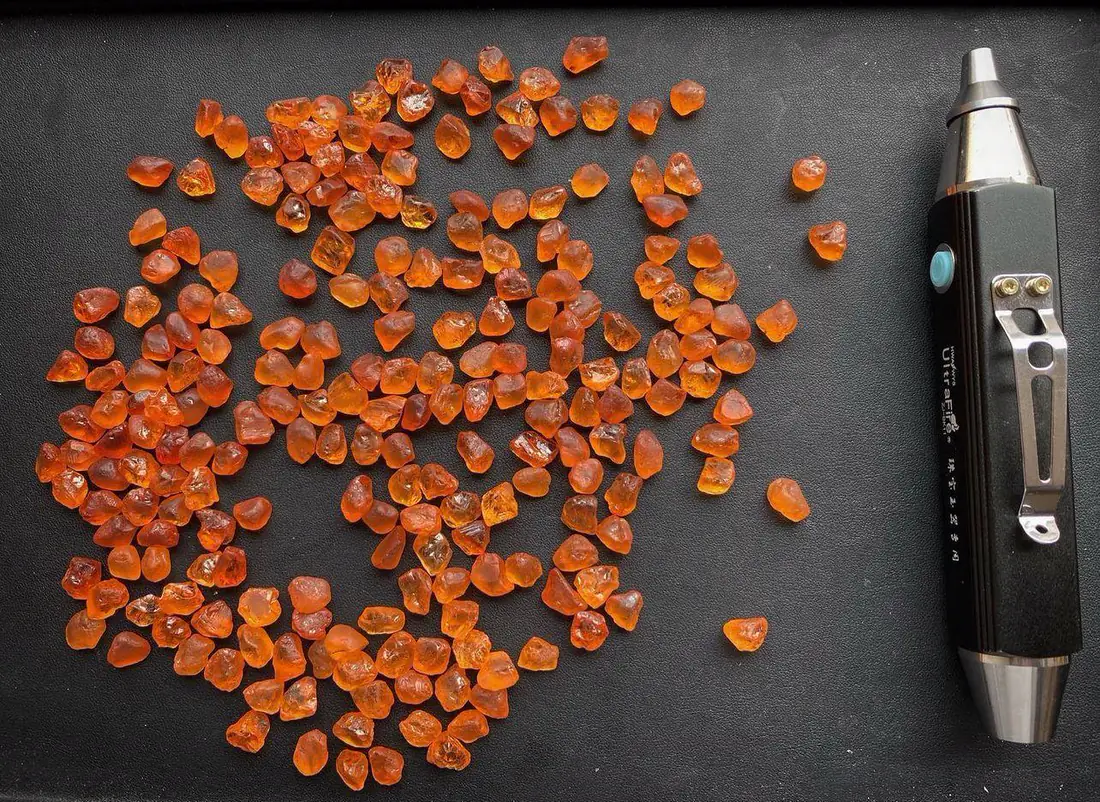
Spessartite is the manganese member of the garnet group. Manganese produces the orange. Iron pulls the colour towards red and brown, and garnets in nature almost always sit somewhere between the two end members rather than at one of them.
So the colour scale is straightforward. The more manganese and the less iron, the purer and brighter the orange. The material everyone calls mandarin sits at the manganese-rich end.
That simplicity is useful when you compare stones. You are essentially judging one axis, from yellow-orange through pure orange to red-orange, and then judging how much brown has crept in.
Where the good material comes from
Namibia produced the original mandarin garnet from the Kunene region in the 1990s, and it set the standard for pure saturated orange. Namibian stones are usually small and frequently included.
Nigeria followed and supplies most of the larger clean material on the market today. Mozambique, Tanzania, Brazil and Sri Lanka all produce spessartite in quantity.
For most buyers, origin is not worth paying for in this species. Colour and clarity carry the value.
No treatment to disclose
There is no routine treatment for spessartite. No heating process improves it, and there is nothing to fill or diffuse.
That removes the entire conversation you would have to have about a ruby or a sapphire. What you see is the natural colour of the stone, permanently.
Clarity is the real constraint
Spessartite grows with characteristic wavy feather inclusions, often described as looking like shredded fabric or ripples inside the stone. They are common enough to be a useful identification clue.
They also limit what is available. Eye-clean spessartite above three carats is genuinely uncommon, and above five carats it becomes a serious search. Buyers comparing a clean 3 carat against a slightly included one are often looking at a much bigger price gap than the size difference suggests.
How it performs
Spessartite sits at 7 to 7.5 on the Mohs scale, with a refractive index around 1.79 to 1.81. Like all garnets it is singly refractive, so the colour is even from every angle.
The high refractive index gives it strong brightness and noticeable fire for a coloured stone. In a well cut piece the orange looks lit from inside rather than painted on. Under warm indoor light it intensifies. In daylight it reads cleaner and more yellow. Look at any stone in both before deciding.
Looking for a stone like this?
We keep stock in Bangkok and answer questions about grading, treatment and price without pressure.

Join the conversation
Ask a question or share what you have seen. We read every comment and reply to the good questions.
Loading comments