
The Black Prince and the Timur
The large red stone at the front of the British Imperial State Crown is spinel. So is the Timur Ruby. Both were called ruby for centuries by people who had no way to tell the difference.
The confusion was reasonable. Spinel is magnesium aluminium oxide and ruby is aluminium oxide, two different minerals, and they grow side by side in the same marble deposits at Mogok in Myanmar. Both come out of the ground red. Separating them needs a refractometer, not an eye.
Much of the historic material came through Badakhshan, from the Kuh-i-Lal workings in what is now Tajikistan. Those stones travelled the same routes and entered the same treasuries as ruby, under the same name.
Why it is an easy stone to own
Spinel sits at 8 on the Mohs scale, above every quartz and most garnet. It handles daily wear in a ring.
It is also singly refractive. Spinel has no birefringence and no pleochroism, so the colour reads the same from every direction. That makes cutting more forgiving and the face-up colour more even than tourmaline or sapphire of the same quality.
The part that matters most to buyers: spinel is rarely treated. There is no routine heat process the way there is for ruby, sapphire and zircon. What comes out of the ground is what reaches the tray.
The colours worth knowing
Chromium produces the reds and hot pinks, the same element that colours ruby. Cobalt produces blue, and cobalt spinel from Luc Yen in Vietnam and from Sri Lanka is the rarest and most expensive material in the species.
Mahenge in Tanzania produced a neon pink-red in 2007 that reset what collectors expect from the stone. Grey, lavender, purple and black all occur, and grey-lavender material has become genuinely fashionable rather than a leftover.
Burmese red remains the benchmark for pure red. Expect an origin report if you are paying a Burma premium.
How we judge a parcel
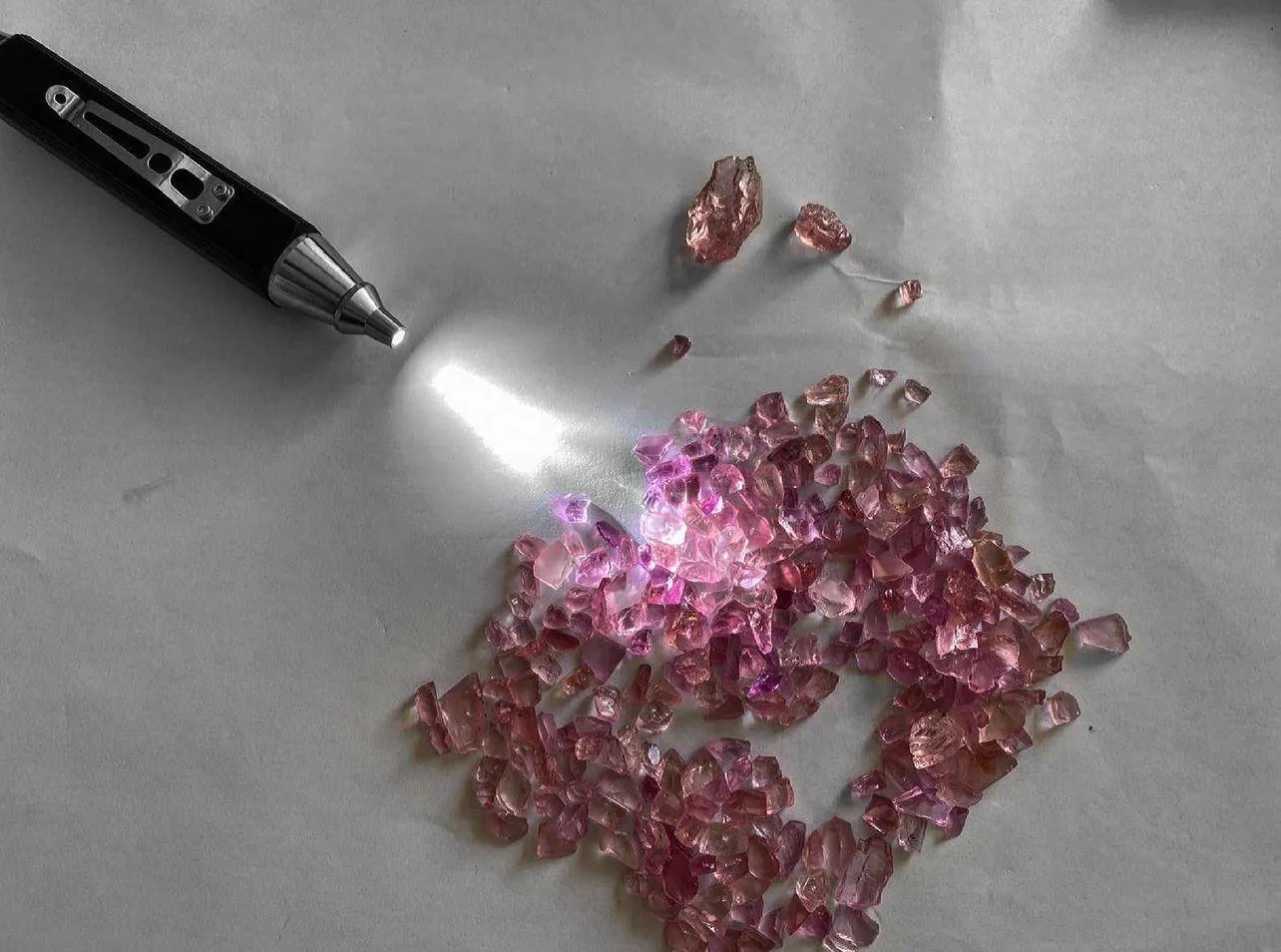
Spread the parcel on white paper and use one point light rather than overhead lighting. Move the torch across the stones and watch which ones hold saturation as the light passes and which ones go grey.
Grey is the enemy in pink and red spinel. It is the single most common reason a stone looks dull in a finished piece despite reading well in a photograph. A stone that stays clean and bright at the edge of the light beam will stay bright on a hand.
In rough, look through the stone for fractures reaching the surface. Spinel takes a beautiful polish, but a fracture that survives cutting limits the setting options later.
What to ask before you pay
Confirm the stone is natural and untreated, and get it in writing. Synthetic spinel has existed since the 1920s and turns up in old jewellery constantly.
If the price depends on Burma or Mahenge, ask for a report that addresses origin. If it depends only on colour and size, a straightforward identification report does the job.
Looking for a stone like this?
We keep stock in Bangkok and answer questions about grading, treatment and price without pressure.

Join the conversation
Ask a question or share what you have seen. We read every comment and reply to the good questions.
Loading comments