
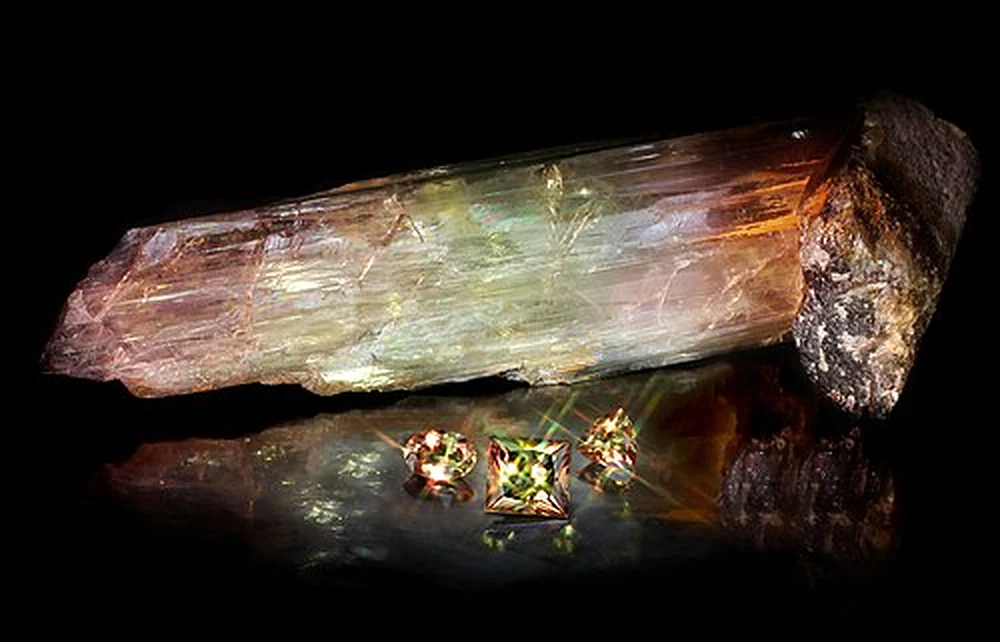
One mountain range in Turkey
Gem quality colour change diaspore comes from the İlbir Mountains in Muğla province, in southwest Turkey. The crystals grow inside bauxite deposits, which are rocks rich in aluminium. No other source produces it in commercial amounts.
Zultanite is a trade name. The mineral is diaspore. You will see the same material sold as Csarite, Ottomanite and Turkizite. Sellers use whichever name they like, so check the description and not the label.
The mineral name dates to 1801, when the French mineralogist René Just Haüy called it diaspore. The word comes from a Greek verb meaning to scatter. Haüy chose it because the crystals crack apart and scatter when you heat them in a flame.
What diaspore is
Diaspore is an aluminium oxide hydroxide, and it forms a large part of bauxite, the ore that supplies the world's aluminium. Most diaspore looks white, grey or brown and never reaches a jeweller. Gem crystals grow in rare pockets where trace elements enter the crystal and give it colour.
The crystals grow as flat, blade like plates. That shape shows up in the finished stones, which often look elongated or pear shaped.
How the colour change works
Zultanite looks yellowish green, olive or champagne in daylight. Under a warm incandescent bulb it turns pink, raspberry or purplish red. The change happens without any treatment. It is a property of the crystal.
The reason is simple. The stone absorbs some parts of the spectrum and lets others through. Daylight carries a lot of blue and green light, so the stone shows green. A warm bulb carries much more red and orange light, so the stone shows pink. The stone does not change. The light that hits it does.
Alexandrite works the same way, and so do a few garnets and sapphires. Diaspore also shows strong pleochroism, which adds another layer of colour when you tilt it.
Why it is hard to cut
Diaspore has perfect cleavage. That means it splits along a flat plane with very little force. A cutter working on a wheel risks splitting the stone in half, and a chip near the edge can spread. Cutters spend more time on zultanite than on a stone of similar size in another species, and they lose more rough.
That effort shows up in the price. It also explains why you should look closely at the outline and the edges. A well cut stone has crisp facets and no small chips along the girdle.
The Mohs hardness sits at 6.5 to 7. That helps it resist scratches. It does not protect it from a knock along the cleavage plane.
Which light shows the change
Colour change depends on the light, so the light you use to test a stone decides what you see. Not every bulb works.
- Daylight
- Sunlight or an overcast sky near a window. Shows the green or champagne side.
- Incandescent and halogen
- These warm bulbs carry plenty of red light. They show the full pink or raspberry side.
- Warm white LED
- Shows part of the change. Bulbs differ, so test the one you own.
- Cool white LED and fluorescent
- These carry little red. Most stones stay green or brown and the pink never appears.
If a stone looks dull in your office, move it under a warm bulb before you judge it.
How to judge the quality
Colour change stones need a different checklist. Colour still leads, but you judge it twice, once under each light.
- Daylight colour
- Look for a clear green, moss or kiwi, not a dull olive or grey.
- Warm light colour
- Look for a strong raspberry or pink, not a brownish beige.
- Strength of the change
- The further apart the two colours sit, the more the stone is worth. A weak change from yellow green to champagne costs far less than green to raspberry.
- Tone
- Medium tone works best. A dark stone hides its change, and a very light stone shows little colour.
- Cut
- Check for a window, an even colour and a clean outline.
No shared scale exists for colour change strength. Every seller judges by eye. Ask to see the stone in daylight and under a warm bulb, or ask for video under both lights. Do this before you agree a price.
Clarity and size
Check every stone for fine cracks along the cleavage planes. Avoid stones with fractures that reach the surface.
Larger clean stones cost sharply more per carat, and stones with a strong colour change cost more again. Compare stones of a similar size when you check prices.
Wearing and caring for zultanite
A stone with perfect cleavage needs a protective setting. A bezel or a halo covers the edges and guards them from knocks. Pendants and earrings suit zultanite best. A ring works, but wear it with care and take it off for housework and exercise.
- Clean gently
- Use warm soapy water and a soft brush. Skip ultrasonic cleaners and steam. Vibration and sudden heat stress the cleavage planes.
- Protect from knocks
- Store it in a soft pouch away from harder stones.
- Tell your jeweller
- Name the stone before any repair or resizing.
How cutters approach diaspore
A cutter studies the crystal for the direction that gives the strongest change and the cleanest colour, then works at low pressure to avoid splitting the stone along the cleavage plane. The work is slow, and any stone that splits gets recut into a smaller one. That is why finished zultanite comes in smaller sizes than the rough suggests.
Zultanite compared with alexandrite
Buyers often ask whether zultanite replaces alexandrite. It does not, but it covers part of the same appeal.
Alexandrite is a variety of chrysoberyl. It rates 8.5 on the Mohs scale, it holds up to daily wear and the finest stones are among the most expensive gems in the world. Its colour moves from bluish green to purplish red. Zultanite moves from yellowish green to pink, costs a small fraction of alexandrite and is much softer.
Choose zultanite if you enjoy a colour change and want a stone you can afford. Choose alexandrite if you want the classic effect and a hard, durable stone. Lab grown colour change stones exist as well. Ask for a report if the stone matters to you.
Other colour change gems
Zultanite belongs to a small group of stones that change colour. The others differ in hardness, price and the kind of change they show.
- Alexandrite
- Hardness 8.5. Bluish green to purplish red. The most valuable and the most durable.
- Colour change sapphire
- Hardness 9. Usually blue or violet in daylight and purple under a warm bulb. The best choice for a ring.
- Colour change garnet
- Hardness 7 to 7.5. Commonly shifts from green or blue green to purple or red. A good middle option for price and toughness.
Each one gives a different trade between beauty, price and durability. Zultanite gives the lowest price and the softest stone.
Looking for a stone like this?
We keep stock in Bangkok and answer questions about grading, treatment and price without pressure.

Join the conversation
Ask a question or share what you have seen. We read every comment and reply to the good questions.
Loading comments